Table of Contents
- Executive Summary: Navigating China’s Textured Yarn Landscape
- Introduction: The Vital Role of Textured Yarns in Modern Textiles
- Understanding Texturization: Core Technologies Explained
- Comprehensive Guide to Chinese Polyester Textured Yarn Types
- Comparative Analysis: Properties, Applications, and Market Positioning
- Key Quality Parameters and Industry Standards
- China’s Manufacturing Ecosystem: Regional Specializations and Leaders
- Supplier Selection Framework for International Buyers
- Technical Specifications and Data Sheets: A Practical Guide
- Innovation and Future Trends in Textured Yarns
- Sourcing Strategies: Cost, Quality, and Compliance Balance
- Conclusion: Building Competitive Advantage Through Smart Yarn Selection
- Frequently Asked Questions (FAQ)
1. Navigating China’s Textured Yarn Landscape
China dominates global production of polyester textured yarns (DTY), offering an unparalleled combination of variety, scale, and value. For procurement professionals, understanding this complex ecosystem is crucial for sourcing the right yarn that balances cost, performance, and sustainability. What are the Types of Chinese Polyester Textured Yarns? This guide provides a comprehensive analysis of Chinese textured yarn types, detailing their unique characteristics, optimal applications, and quality benchmarks. Key insights reveal that successful sourcing requires matching specific texturization technologies—such as false-twist, air-jet, or draw-texturing—with end-use requirements in apparel, home textiles, or technical fabrics. The market is stratified, with premium suppliers offering specialized, high-consistency yarns for demanding applications, while large-scale manufacturers cater to bulk commodity needs. A data-driven approach to supplier selection, focusing on technical capabilities and compliance certifications, is essential for optimizing value and mitigating supply chain risks.
2. The Vital Role of Textured Yarns in Modern Textiles
Textured yarns represent a transformative advancement in synthetic fibers, converting flat, straight polyester filaments into bulky, stretchy, and softer yarns that mimic natural fibers like cotton and wool. This process not only enhances aesthetic and tactile properties but also improves moisture management, insulation, and dyeability. China’s leadership in this sector stems from decades of investment in advanced machinery, process optimization, and massive production scale. For international buyers across apparel, home furnishing, and industrial sectors, accessing China’s textured yarn portfolio means unlocking versatility, cost-efficiency, and innovation for their products.
3. Understanding Texturization: Core Technologies Explained
The properties of textured yarns are fundamentally determined by the manufacturing technology.
- False-Twist Texturing (FTT): The most common method for producing Draw Textured Yarn (DTY). Filaments are twisted, heat-set, and then untwisted, creating a helical crimp that provides bulk and moderate stretch. It is highly versatile and efficient.
- Air-Jet Texturing (ATY): Uses high-pressure air to entangle filaments, creating loops and a bulky, spun-yarn-like appearance with minimal stretch. Excellent for cover and a natural feel.
- Stuffing Box Texturing: Compacts the yarn into a heated box, creating a random crimp structure. Often used for bulk without the need for high elasticity.
- Knit-Deknit Texturing: Involves knitting the yarn into a fabric, heat-setting it, and then unraveling it to retain the knitted loop structure. It produces high bulk but is less common due to cost.
- Bicomponent Texturing: Uses two polymers with different shrinkage rates. When heated, differential shrinkage creates a helical crimp, offering superior elasticity and bulk (e.g., in PTT/PET hybrids).
4. Comprehensive Guide to Chinese Polyester Textured Yarn Types
Table 4.1: Primary Textured Yarn Types & Defining Features
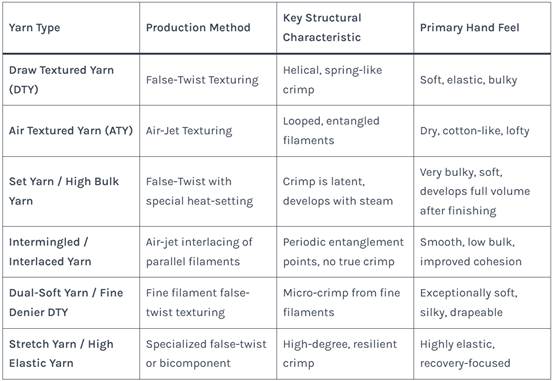
Specialty Variants from China:
- Bright DTY: Standard luster for a glossy finish.
- Semi-Dull / Full-Dull DTY: Reduced luster for a more natural, matte appearance.
- Deep Dye DTY: Modified polymer for richer, more vibrant colors.
- Cationic Dyeable DTY: Can be dyed with cationic dyes, allowing for multi-color effects with regular polyester.
- Solution-Dyed DTY: Pigment incorporated during polymer stage for superior colorfastness.
5. Comparative Analysis: Properties, Applications, and Market Positioning
Table 5.1: Technical Comparison and Application Matrix
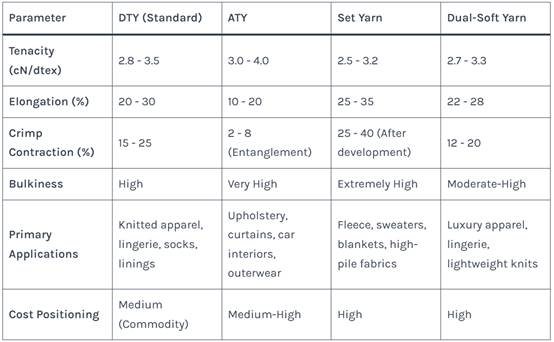
6. Key Quality Parameters and Industry Standards
Evaluating yarn quality goes beyond basic denier and strength. Critical parameters include:
- Crimp Properties: Crimp contraction %, crimp modulus, and crimp stability determine elasticity and bulk.
- Evenness (Uster %): Measures thickness variation. Premium yarns target Uster CV% < 0.8%.
- Dyeadility Uniformity: Critical for consistent shade. Assessed through barre tests in knitted fabrics.
- Oil Content: Typically 0.8-1.5%. Must be uniform for smooth knitting/weaving.
- Shrinkage: Boil-water shrinkage should be controlled and consistent (e.g., 2-5% for DTY).
- Standards: Suppliers should comply with international testing norms (ASTM, ISO, GB). Certifications like OEKO-TEX Standard 100 are essential for apparel.
7. China’s Manufacturing Ecosystem: Regional Specializations and Leaders
- Zhejiang & Jiangsu Provinces: The heartland, specializing in high-quality, versatile DTY for apparel. Home to integrated giants like GLYarn, Hengli Group, and Shenghong Group.
- Fujian Province: Strong in differentiated yarns, especially fine-denier, dual-soft, and functional DTY.
- Guangdong Province: Focus on yarns for knitting applications and rapid response to fashion trends.
- Supplier Tiers:
- Tier 1: Vertically integrated (chip to yarn), massive scale, full R&D (e.g., Rongsheng Petrochemical).
- Tier 2: Large-scale, dedicated texturing mills with strong technical capabilities.
- Tier 3: Smaller, niche players focusing on specialty or localized markets.
8. Supplier Selection Framework for International Buyers
A systematic approach mitigates risk:
- Define Need: Specify yarn type, denier, filament count, luster, and key performance attributes for your end-use.
- Long-list Creation: Use B2B platforms, trade shows (Yarn Expo), and industry referrals.
- Technical Qualification: Request detailed technical data sheets (TDS). Ask for sample cones for in-house testing. Evaluate consistency across multiple sample batches.
- Capability Audit: Assess production technology (machine brands like Barmag, TMT), quality control labs, and R&D focus.
- Compliance Check: Verify relevant certifications (OEKO-TEX, GRS for recycled content).
- Commercial Assessment: Evaluate pricing structure, MOQ flexibility, lead times, and export experience.
9. Technical Specifications and Data Sheets: A Practical Guide
A credible TDS from a Chinese supplier should include:
- Basic Specs: Denier (e.g., 150D/96F), luster, cross-section.
- Mechanical Data: Tenacity, elongation, crimp contraction, boil-water shrinkage.
- Evenness Data: Uster CV%, imperfections.
- Application Recommendation: Suggested knitting/weaving parameters.
- Certification References: Test report numbers for key standards.
10. Innovation and Future Trends in Textured Yarns
- Sustainable Texturing: Energy-efficient machines, bio-based or recycled polyester DTY (rPET DTY), and eco-friendly spin finishes.
- Functional Yarns: Incorporation of additives for moisture-wicking, UV protection, anti-microbial, or flame-retardant properties at the texturing stage.
- Superfine & Ultra-Soft: Advancements in spinning fine filaments (<0.5 dpf) for next-level softness.
- Digitalization & Smart Manufacturing: AI-driven process control for hyper-consistency and predictive maintenance.
11. Sourcing Strategies: Cost, Quality, and Compliance Balance
- For High-Volume Commodity Needs: Engage directly with Tier 1 integrated producers for best cost and stable supply.
- For Specialized / Performance Yarns: Partner with Tier 2 specialists known for innovation and flexibility.
- For Small Batches & Trials: Use established trading companies with technical expertise, but insist on direct mill engagement.
- Risk Mitigation: Always conduct pre-shipment inspections. Diversify suppliers regionally within China to avoid disruption.
12. Building Competitive Advantage Through Smart Yarn Selection
The diversity of Chinese polyester textured yarns offers a powerful toolkit for product developers and procurement managers. The strategic choice is not merely about finding a supplier but about identifying the precise yarn technology that enhances your product’s functionality, appeal, and value. By combining a deep technical understanding of yarn types with rigorous, data-backed supplier evaluation, international buyers can forge partnerships that deliver consistent quality, drive innovation, and secure a competitive edge in their respective markets.
13. Frequently Asked Questions (FAQ)
Q1: What is the difference between POY, FDY, and DTY?
A: POY (Partially Oriented Yarn) is the semi-finished product before texturing. FDY (Fully Drawn Yarn) is a smooth, straight filament yarn. DTY (Draw Textured Yarn) is made by drawing and texturing POY, giving it bulk and stretch. DTY is the primary focus for textured apparel fabrics.
Q2: For a high-quality fleece fabric, which yarn type is best?
A: High-Bulk Set Yarn is specifically engineered for fleece. Its latent crimp develops dramatically during steaming and brushing, creating the characteristic lofty, warm, and soft pile of premium fleece fabrics.
Q3: Can I get certified recycled polyester (GRS) textured yarn from China?
A: Yes. Leading manufacturers now offer GRS-certified rDTY (Recycled Draw Textured Yarn). Ensure the supplier provides valid GRS Transaction Certificates for each shipment to verify recycled content.
Q4: What does “150D/144F” mean?
A: This is a standard denier specification. “150D” means the yarn size is 150 denier (weight in grams per 9000 meters). “/144F” means it is composed of 144 individual filaments. A higher filament count with the same denier (finer filaments) results in a softer yarn.
Q5: How important is the brand of texturing machine?
A: Very important. Top-tier European (Barmag, Oerlikon) and Japanese (TMT, Murata) machines offer better precision, energy efficiency, and yarn consistency. Inquiring about machinery is a good proxy for a mill’s commitment to quality.
Q6: What are typical MOQs for custom-color DTY from China?
A: For standard colors from stock, MOQs can be 500-1000 kg. For custom-dyed (yarn-dyed) DTY, MOQs from major mills typically start at 3-5 tons per color. Solution-dyed DTY offers lower color MOQs (1-3 tons).
Q7: How do I test the quality of yarn samples before placing a bulk order?
A: Beyond data sheets, knit or weave a small fabric sample. Assess for: Barre’ (stripes) – indicates uneven dye uptake or yarn tension; Pilling – test on a Martindale pilling tester; Hand Feel – subjective but crucial; Color Consistency – compare cones under standard light.
Q8: What is “intermingled” yarn used for?
A: Intermingled yarn (often POY or FDY) has periodic air-jet tangles that hold filaments together without crimp. It’s used where a smooth fabric surface is needed but filament separation (splitting) must be prevented, such as in lightweight woven linings and sheer fabrics.
Q9: Are there anti-pilling textured yarns available?
A: Yes. Anti-pilling DTY is produced using higher viscosity polymer and/or modified cross-section filaments that resist breaking and forming pills. It’s specified for applications requiring durable surface integrity, like school uniforms or performance knits.
Q10: What are standard payment terms for new buyers?
A: 30% advance payment by T/T and 70% against copy of Bill of Lading is common. For established relationships, 30-day terms after B/L may be negotiated. Letters of Credit (L/C) are also widely accepted.