You have talked to three agencies this month. All of them said “AI-powered.” All of them showed impressive decks. None of them could explain what their AI actually does differently. You are not alone in this frustration.
The AI SEO agency market is flooded with rebranded services. Separating genuine capability from marketing theater requires asking the right questions and knowing which answers matter.
What Most AI SEO Agencies Get Wrong
They lead with tools instead of outcomes. “We use GPT for content” is not a differentiator. Every agency has access to the same foundational models. The value lives in how an agency applies AI to your specific growth problems.
The second failure is measurement theater. Agencies show dashboards full of vanity metrics. Impressions up. Keywords tracked. Content pieces published. None of these connect directly to revenue or AI platform visibility.
If an agency cannot draw a straight line from their AI work to your pipeline, they are selling activity, not results.
Criteria for Evaluating AI SEO Agencies
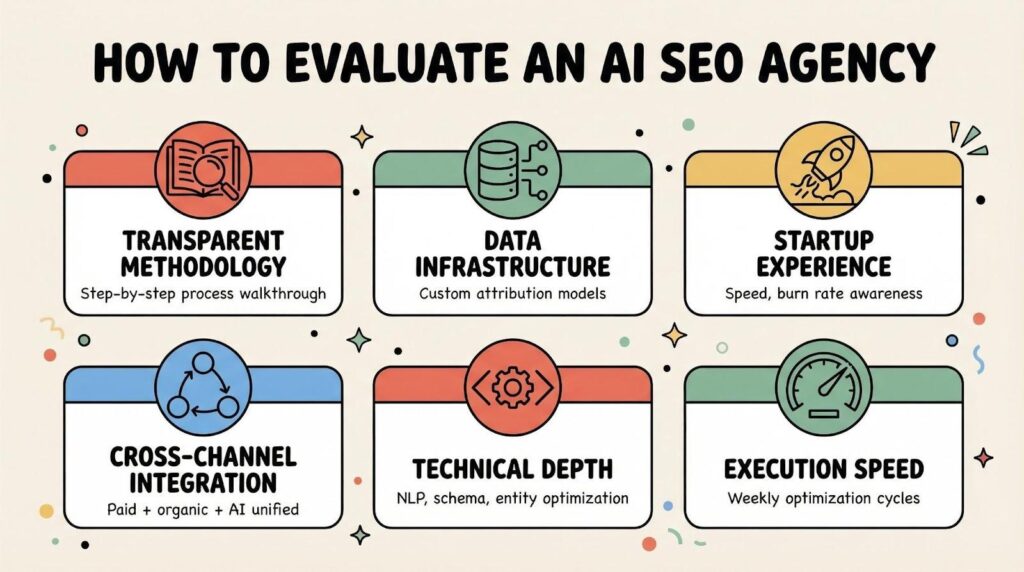
Transparent Methodology
Ask them to walk you through their process step by step. A credible agency explains how they analyze your current AI visibility, where they focus optimization efforts, and how they measure outcomes. Vague answers about “proprietary AI systems” are a red flag.
Data Infrastructure and Attribution
The agency should have systems to track how AI search platforms surface your content. This means custom attribution models, not just Google Analytics. Ask what data sources they use and how they attribute conversions from AI-driven traffic.
Startup and Growth-Stage Experience
Working with enterprise clients and working with startups demand different muscles. An agency experienced with VC-backed companies understands speed constraints, burn rate awareness, and the need to show results within weeks. Teams proficient in ai engine optimization for startups know how to prioritize ruthlessly.
Cross-Channel Integration
AI SEO does not work in isolation. Your agency should integrate organic AI visibility with paid search, content marketing, and conversion optimization. Siloed teams produce fragmented results that leave gaps competitors exploit.
Technical Depth
Ask about their engineering resources. Real AI SEO requires structured data implementation, NLP analysis, entity optimization, and automated monitoring. An agency with only content writers and account managers lacks the technical foundation.
Execution Speed and Partnership Model
Quarterly strategy refreshes are too slow. Your agency should operate as an embedded partner. Weekly optimization cycles. Direct access to practitioners. Fast feedback loops that match your growth pace.
Practical Tips for the Evaluation Process
Run a paid pilot before signing annual contracts. Give the agency a defined scope and thirty days. Measure their communication, technical depth, and ability to deliver tangible outputs. Pilots reveal more than pitch decks.
Ask for client references at your stage. An agency crushing it for Fortune 500 brands may struggle with your budget and timeline. Get references from companies at your revenue stage and growth trajectory.
Test their diagnostic capability. A strong agency should identify specific AI visibility gaps during the sales process. If their discovery call produces generic recommendations, their execution will be generic too. The best agencies practicing ai engine optimization demonstrate diagnostic depth before you sign anything.
Evaluate their reporting against your KPIs. Share your actual business metrics. Ask how they would report against them. If they push back toward vanity metrics, they are not aligned with your outcomes.
Check their team structure. Ask who will do the actual work. If the senior strategist disappears after the sale and you get a junior coordinator, that tells you everything about their delivery model.
Waiting to Decide Is Still a Decision
Every month you spend evaluating without acting is a month your competitors spend building AI visibility. The compounding nature of AI search authority means early movers gain advantages that become increasingly expensive to overcome.
You do not need a perfect agency. You need a capable one that moves fast and measures what matters. The founders and marketing leaders who win this transition are the ones who commit to a partner, set clear benchmarks, and iterate aggressively.
The risk of hiring the wrong agency is real. But the risk of staying still while AI reshapes how buyers find solutions is greater. Evaluate with rigor. Decide with urgency.